Showing posts with label UNWTO. Show all posts

Friday, 31 March 2023

UNWTO digs deeper to uncover more top tourism villages


Following two successful editions of its hunt for the world’s most outstanding tourism villages that are able to drive rural development and local well-being, UNWTO has opened its third call for applications to its Best Tourism Villages initiative.

Launched in 2021, the initiative is one of the pillars of UNWTO Tourism for Rural Development Programme. It has recognised more than 70 tourism villages from almost 40 countries. Qualification is determined by an independent advisory board based on a set of criteria covering nine areas, including Cultural and Natural Resources; Economic Sustainability; Tourism Development and Value Chain Integration; and Health, Safety, and Security.

Here in Asia, the tourism villages of Malaysia’s Batu Puteh; Philippines’ Bojo; Japan’s Miyama; Indonesia’s Nglanggeran; India’s Pochampally; South Korea’s The Purple Island, Ungok and Pyeongsa-ri; China’s Xidi, Yucun, Dazhai and Jingzhu; and Vietnam’s Thái Hải were awarded the recognition over the last two years.

Besides recognising tourism villages that meet all nine stringent requirements, the initiative also encompasses an Upgrade Programme, which helps villages just shy of making the cut to address gaps identified in the evaluation process; and the Best Tourism Villages by UNWTO Network, which brings representatives of both recognised villages and those in the Upgrade Programme together to trade experiences and good practices.

UNWTO secretary-general Zurab Pololikashvili said: “Tourism can make a real difference for rural communities, delivering jobs, supporting businesses and celebrating and protecting traditions. Through Best Tourism Villages, UNWTO is recognising those rural destinations that committed to making tourism a pillar of opportunity and well-being.”

UNWTO’s Members States can present up to eight villages through their National Tourism Administrations (NTAs) and via this form Application-Form-EN-2023.docx (live.com)

Applications will close on June 23, 2023, and the winners announced later this year.

-TTG Asia.

Tuesday, 29 November 2022

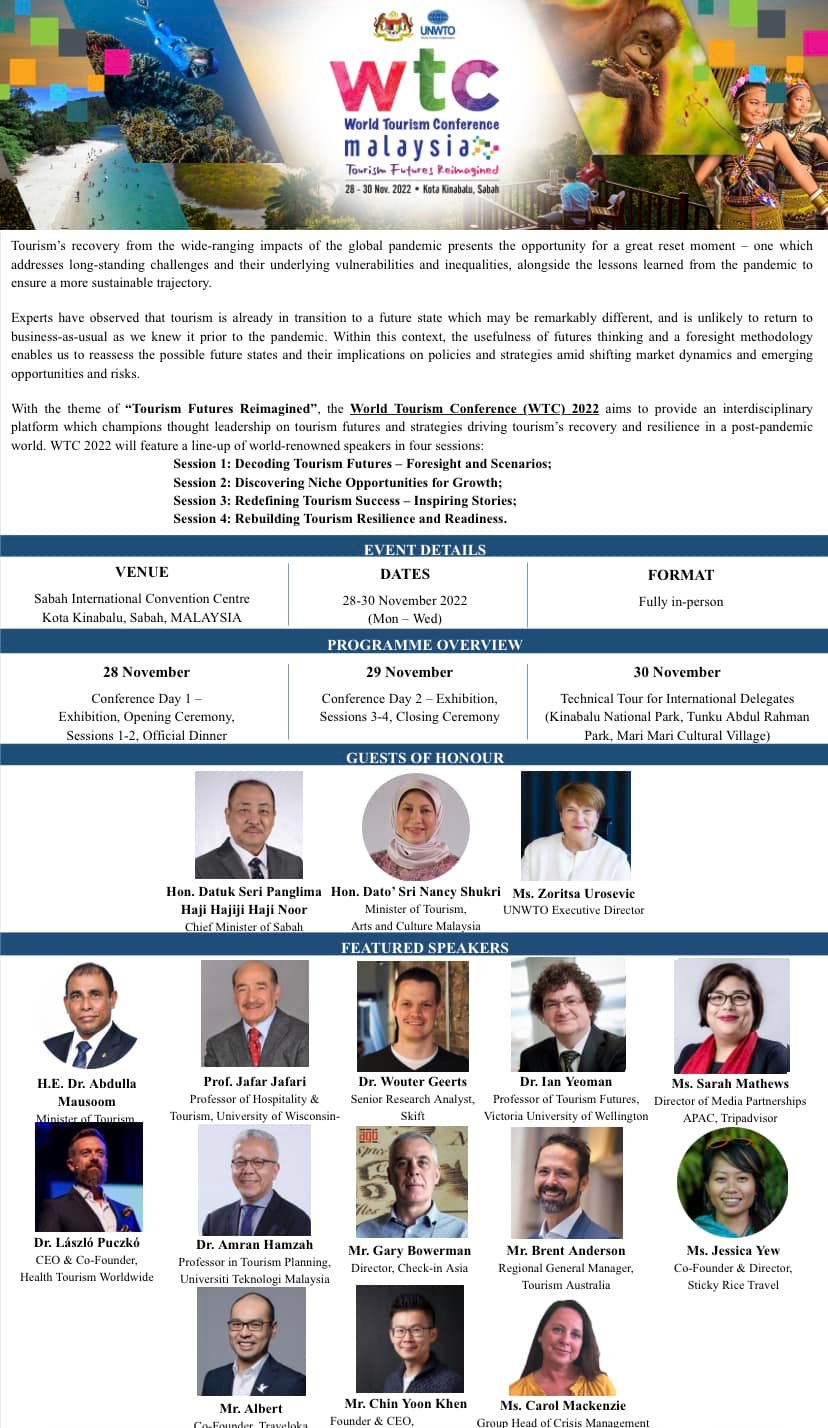
World Tourism Conference 2022: Tourism Futures Reimagined @ Sabah, Malaysia ( 28 ~ 30 November 2022 )


28 November 2022 – The World Tourism Conference (WTC) 2022 jointly organised by the Ministry of Tourism, Arts and Culture Malaysia in partnership with the World Tourism Organization (UNWTO) and Sabah State Government runs from 28-30 November 2022 at the Sabah International Convention Centre (SICC), Kota Kinabalu, Sabah. Now in its 6th edition, this year’s conference brings together 1,000 delegates from more than 60 countries to reconnect and reassess tourism’s recovery in the aftermath of the worldwide pandemic. 

Alongside UNWTO officials, the conference features some 30 expert speakers comprising government policy makers, industry leaders and leading academicians in championing thought leadership on tourism futures and strategies driving tourism’s recovery and resilience in a post-pandemic world.

They include the State Minister, Ministry of Tourism Maldives, Dr. Ahmed Salih; Regional General Manager, Tourism Australia, Mr. Brent Anderson; Professor Emeritus, University of Wisconsin-Stout, USA, Prof. Jafar Jafari; Co-founder of Traveloka, Indonesia, Mr. Albert; and representatives from some of the world’s most innovative tourism-related companies such as Skift, Tripadvisor, TUI Group and Intrepid Travel. 

Local Malaysian experts making an appearance on the exclusive WTC 2022 stage include Prof. Dr. Amran Hamzah of Universiti Teknologi Malaysia; Mr. HC Chan, CEO of Sunway Malls & Theme Parks; Ms. Lau Yin May, Group Chief Marketing and Customer Experience Officer, Malaysia Airlines; Mr. Yusno Yunos, CEO of Evenesis and two local Sabahans from Kota Kinabalu – Dr. Maklarin Lakim, Director of Sabah Parks; and Ms. Jessica Yew, Founder and Director of Sticky Rice Travel. 

One of the major highlights of the conference is the keynote presentation by distinguished speaker, Prof. Dato’ ChM. Dr. Mazlin Mokhtar of the UN Sustainable Development Solutions Network-Asia and Academy of Sciences Malaysia, who will for the first time bring a scientist’s perspective to the WTC, particularly in advancing a more sustainable tourism recovery which embraces energy transition and carbon neutrality. 

In her welcoming address, Datuk Hajah Saraya Arbi, Secretary-General of the Ministry of Tourism, Arts and Culture Malaysia acknowledged the tremendous impact of the worldwide pandemic and multiple crises which continue to disrupt the tourism sector’s growth trajectory. 

“However, there is also a great window of opportunity for us to rethink and reimagine tourism for the future which is more sustainable, inclusive and less susceptible to shocks,” she said. 

Despite challenging headwinds to the global economy in 2023 and beyond, experts have great expectations for the tourism sector, predicting continued pent-up demand alongside new growth opportunities and emerging niche markets arising from the pandemic. For instance, as tourism recovery gets underway, the boundaries between work, home, leisure and travel become increasingly blurred, requiring greater cross-collaboration between tourism and transport, health, security, cities and urban systems towards greater liveability and quality of life for both visitors and residents alike. 

“These are just some of the exciting new prospects that will be explored during the 2-day conference. Therefore, I hope the chosen theme of “Tourism Futures Reimagined” will inspire deep insights on the challenges, opportunities, trends and forecasts shaping the future of the industry,” Saraya concluded.

-MOTAC.

Saturday, 3 September 2022

World Tourism Conference 2022 @ Kota Kinabalu, Sabah, Malaysia ( 28 ~ 30 October 2022 )


Tourism Futures Reimagined - World Tourism Expo 2022 in Kota Kinabalu, Sabah. Register Now!

The Ministry of Tourism, Arts and Culture Malaysia (MOTAC) and the World Tourism Organization (UNWTO) will jointly organise the 6th World Tourism Conference (WTC) 2022 on 28-30 November 2022 in Kota Kinabalu, Sabah, Malaysia.

Themed “Tourism Futures Reimagined”, the conference aims to provide an interdisciplinary platform which champions thought leadership on tourism futures and strategies driving tourism’s recovery and resilience in a post-pandemic world. 

WTC 2022 will feature a line-up of world-renowned speakers in four sessions:

Session 1: Decoding Tourism Futures – Foresight and Scenarios;

Session 2: Discovering Niche Opportunities for Growth;

Session 3: Redefining Tourism Success – Inspiring Stories;

Session 4: Rebuilding Tourism Resilience and Readiness.

Registration is now open for the World Tourism Conference (WTC) 2022!

Malaysian

https://form.evenesis.com/WTC2022/Local

International Delegates

https://form.evenesis.com/WTC2022/International

WTC 2022 is an inspiring addition to Malaysia’s 2022 Calendar of Events with a full return to in-person participation, in line with Malaysia’s reopening of international borders since 1st April 2022. 

More info here https://www.unwto.org/event/6-world-tourism-conference-2022

-Tourism Malaysia.

Wednesday, 27 July 2022

Sabah will host World Tourism Conference 2022 in November


KOTA KINABALU: Sabah will host the World Tourism Conference (WTC 2022) in Kota Kinabalu from Nov 28 to 30.

Themed "Tourism Futures Reimagined", the WTC 2020 is targeting 700 international and local delegations, including tourism ministers, senior government officials, academics and tourism industry figures from around the world.

Federal Tourism, Arts and Culture Minister Datuk Seri Nancy Shukri said this to Sabah Chief Minister Datuk Seri Hajiji Noor during a courtesy call at his office at Menara Kinabalu today.

Hajiji welcomed the upcoming conference and hoped that it would boost the recovery of the state's tourism industry.

According to Nancy, the organisation of WTC 2022 will be carried out in a strategic collaboration between the ministry and the Sabah government via the Sabah Tourism Board.

She said WTC is an exclusive conference organised by Malaysia in collaboration with the World Tourism Organisation (WTO).

The conference is held every three years and this will be the sixth time Malaysia is hosting following the success of the fifth edition.

For Sabah, this will be the second time that Kota Kinabalu has been selected to host the conference, she said.

This was a sign of recognition to the commitment and leadership shown by the state government which emphasised the development of the tourism sector in making Sabah a major world travel destination, she said.

Present at the meeting were State Secretary Datuk Seri Safar Untong, Tourism, Arts and Culture Minister deputy secretary general (tourism) Mohd Zamri Mat Zain and senior ministry officials.

-nst online.

Thursday, 8 July 2021

Vaccines, digital solutions give impetus to travel recovery: UNWTO


The global vaccination rollout and increased adoption of digital solutions for safe travel should lead to a rise in international mobility over the weeks and months ahead, the latest data from the UNWTO has shown.

According to the newest edition of the Travel Restrictions Report from the UN agency, as of June 1, 29 percent of all destinations worldwide have their borders completely closed to international tourism.

Of these, more than half have been completely closed to tourists since May 2020 or longer, with the majority of these belonging to the SIDS (small island developing states) of Asia and the Pacific. In comparison, just three destinations (Albania, Costa Rica, Dominican Republic) are completely open to tourists, with no restrictions now in place.

One in three (34 percent) of all destinations are partially closed, and 36 percent require a negative Covid-19 test result upon arrival, and in some cases, in combination with a quarantine requirement.

The data confirmed the trend towards destinations adopting more nuanced, evidence-and-risk-based approaches to restrictions on travel, particularly in light of the evolving epidemiological situation and the emergence of new variants of the virus. Indeed, 42 percent of all destinations have introduced specific restrictions for visitors from destinations with variants of concern, ranging from the suspension of flights and closing of borders to compulsory quarantine.

Additionally, since most of those destinations with the strictest measures have some of the lowest rates of vaccination, the data also indicated a link between vaccination speed and easing of restrictions. In comparison, those destinations that have higher rates of vaccination and where countries are able to work together on harmonised rules and protocols such as those being employed in the Schengen area of the European Union, are better-placed to allow tourism to slowly return.

“Governments are instrumental for the restart and recovery of tourism through collaboration, use of data and digital solutions”, said UNWTO secretary-general Zurab Pololikashvili.

Regional differences with regards to travel restrictions remain. 70 percent of all destinations in Asia and the Pacific are completely closed, compared with just 13 percent in Europe, as well as 20 percent in the Americas, 19 percent in Africa and 31 percent in the Middle East.

Assessing current requirements for vaccinated passengers, 17 percent of all destinations worldwide specifically mention vaccinated passengers in their regulations. In most cases, travel restrictions continue to apply to fully vaccinated passengers (who have received two doses of an approved vaccine), though in others, all restrictions are lifted. UNWTO expects that this will significantly evolve over the coming weeks.

The report indicated that the restart of global tourism will remain muted so long as governments continue to advise caution. Four of the 10 top source markets, which generated 25 percent of all international arrivals in 2018, keep advising their citizens against non-essential travel abroad.

-TTG Asia.

Friday, 28 May 2021

UNWTO, Google scale up collaboration to drive tourism recovery


UNWTO has signed a MoU with Google to collaborate on harnessing the power of innovation, education, data and market intelligence to drive a sustainable and inclusive recovery for global tourism.

The new MoU builds on past cooperation between the UN specialised agency for tourism and Google, and comes as destinations in some parts of the world look to restart their tourism engines.

Notably, the two organisations will host trainings for DMOs, using a new Capacity Building Curriculum developed by Google. These sessions will empower destinations to switch to digital, with the training adapted to reflect their specific circumstances and the unique challenges every destination currently faces.

The new Capacity Building Curriculum will also complement existing joint initiatives, and a data sharing agreement for Google’s Travel Insights to power a portion of the UNWTO’s tourism recovery tracker.

Alongside this, the Tourism Accelerator Program, designed by Google in partnership with UNWTO, will also be scaled up globally. A pilot programme launched across EMEA (Europe, Middle East, Africa) in 2020 showed the value of working with policymakers to put digital at the heart of their tourism recovery plans and the benefits of upskilling DMOs so they can make effective use of data and market intelligence.

The partnership will go beyond empowering destinations and businesses during the immediate recovery phase. Under the agreement, Google will provide ongoing support for a number of UNWTO’s leading initiatives, including Startup Competitions designed to promote and support innovation across the sector.

UNWTO secretary-general Zurab Pololikashvili said: “The strong partnership between UNWTO and Google will help put innovation and digital at the centre of tourism’s recovery. By working together, UNWTO and Google will empower destinations, businesses and tourism workers to realise the power of data and market intelligence, both increasingly important as global tourism looks to restart and recover.”

Looking ahead, UNWTO and Google will also collaborate on joint research projects related to tourism, providing governments, destinations and businesses with the data and insights to guide tourism towards recovery.

-TTG Asia.

Wednesday, 7 October 2020

UNWTO, IATA form alliance to get airlines flying again


Ahead of the G20 summit of the world’s largest economies, which includes a dedicated tourism segment, the UNWTO has signed an MoU with the IATA, to restore consumer confidence in air travel, while placing sustainability at the centre of recovery and future growth.


As well as focusing on building and maintaining confidence in international travel, the new agreement will also see UNWTO and IATA work closely together to foster innovation and promote greater public-private collaboration. As tourism restarts, this MoU will help ensure recovery is sustainable and inclusive.


IATA director general Alexandre de Juniac said: “The safe opening of international borders to tourism is essential. Tourists want to feel safe, and they want to be confident that their travel plans won’t be affected by last-minute changes to rules and regulations. For this to happen, even greater collaboration between the public and private sectors is needed.”


IATA has been an affiliate member of UNWTO since 1978, providing a strong voice for the international air transport sector. IATA is also an active member of the board of the UNWTO’s affiliate members and contributed to the UNWTO Global Guidelines to Restart Tourism, released in May to help guide governments and the private sector in their response to the Covid-19 pandemic.


The guidelines included a distinct set of recommendations for the air transport sector, with a focus on the introduction of enhanced hygiene protocols to guarantee the safety of both passengers and airline workers. It also emphasised the need for strong partnership and coordination at every level of the airline sector.

-TTG Asia.

Sunday, 27 September 2020

WORLD TOURISM DAY 2020: Global Community Unites To Celebrate “Tourism And Rural Development"


Celebrated on 27 September with the theme of Tourism and Rural Development, this year’s international day of observation comes at a critical moment, as countries around the world look to tourism to drive recovery, including in rural communities where the sector is a leading employer and economic pillar.

The 2020 edition also comes as governments look to the sector to drive recovery from the effects of the pandemic and with the enhanced recognition of tourism at the highest United Nations level. This was most notably illustrated with the recent release of a landmark Policy Brief on tourism from UN Secretary-General Antonio Guterres in which he explained that “for rural communities, indigenous peoples and many other historically marginalized populations, tourism has been a vehicle for integration, empowerment and generating income.”

All around the world, tourism empowers rural communities, providing jobs and opportunity, most notably for women and youth

Historic International Cooperation

For the first time in the 40-year history of World Tourism Day, the official celebration will not be hosted by a single Member State of the United Nations specialized agency. Instead, nations from the MERCOSUR Member States (Argentina, Brazil, Paraguay and Uruguay, with Chile joining as Member Associate status) will serve as joint hosts. This co-hosting agreement exemplifies the spirit of international solidarity that runs through tourism and which UNWTO has recognized as essential for recovery.

UNWTO Secretary-General Zurab Pololikashvili said: “All around the world, tourism empowers rural communities, providing jobs and opportunity, most notably for women and youth. Tourism also enables rural communities to hold onto their unique cultural heritage and traditions, and the sector is vital for safeguarding habitat and endangered species. This World Tourism Day is a chance to recognize the role tourism plays outside of major cities and its ability to build a better future for all.”

Rural areas hit hard by COVID-19

For countless rural communities around the world, tourism is a leading provider of employment and opportunities. In many places, it is one of the few viable economic sectors. Moreover, development through tourism can also keep rural communities alive. It is estimated that by 2050, 68% of the world population will live in urban areas, while 80% of those currently living in ‘extreme poverty’ live outside of towns and cities.

The situation is particularly hard for youth: young people in rural communities are three times more likely to be unemployed than older adults. Tourism is a lifeline, offering young people a chance to earn a living without having to migrate either within their home countries or abroad.

World Tourism Day 2020 will once again be celebrated by UNWTO’s Member States in all global regions as well as by cities and other destinations and by private sector organizations and individual tourists. It comes as communities in rural areas also struggle with the impacts of the COVID-19 pandemic. These communities are usually much less-prepared to deal with the short and longer-term impacts of the crisis. This is due to a number of factors, including their aging populations, lower income levels and the continuing ‘digital divide’. Tourism offers a solution to all of these challenges.

-UNWTO.

Wednesday, 5 August 2020

UNWTO advocates accessible tourism in the new normal

As tourism restarts, the UNWTO is calling on destinations to recognise and cater for the needs of travellers with disabilities or specific access requirements.


In partnership with the Once Foundation of Spain and the European Network for Accessible Tourism (ENAT), the UN agency has released a set of guidelines to ensure accessibility and inclusivity for all in the new reality.


The Reopening Tourism for Travellers with Disabilities guide also notes the opportunities available to destinations that take steps to accommodate the specific needs of persons with disabilities, those with specific access requirements and seniors.


The guidelines are a set of basic recommendations aimed at helping stakeholders, including accommodation providers, bars, restaurants and tourism offices, adjust to new health and sanitary demands without reducing accessibility.


The recommendations cover four distinct areas:


• Travel planning and protocols: Including steps to guarantee seamless travel, and for making relevant information available and accessible to all


• Transportation: Including the importance of upskilling employees, adjusting protocols for passengers with disabilities/access requirements at airports and stations, as well as the provision and hygienic upkeep of mobility equipment


• Accommodation, bars and restaurants: Focusing on accessibility to cater for different needs of clients, guaranteeing social distancing, and enhanced hygiene procedures in all tourism-related establishments


• Tourist activities: Including recommendations to help destinations and attractions adapt existing protocols by taking into account accessibility issues related to queuing, health and safety measures, and new venue capacities


UNWTO secretary-general, Zurab Pololikashvili, said: “Much progress has been made in making tourism more accessible to all. As we guide the responsible restart of tourism, we must make sure that this progress is not rolled back. Instead, it must be stepped up as it will benefit everyone. These guidelines, produced in collaboration with Once Foundation and ENAT show that simple, thoughtful measures can make a real difference for travellers – and in return, allow destinations to welcome this wide and diverse demographic as they look to recover from Covid-19.”


Fundación Once vice-president, Alberto Durán, underlined: “It is fundamental that we use this time of change to sensitise all stakeholders to the need to include persons with disabilities and their families in tourism, leaving no one behind. These clients can help businesses stay afloat in these challenging times, representing opportunities for all.”


The full set of recommendations can be downloaded here.

-TTG Asia.

Friday, 3 July 2020

Will a digital health passport help us fly again?

Biometric identification that helps verify an individual’s health status can help restart air travel

National governments in Asia, Australia and Europe have rolled out contact-tracing apps to curb the spread of Covid-19 on home soil, but what if similar technology could be harnessed in the skies and effectively bring the travel industry back to life?
• Biosecurity clearance that supports a ‘test and trace’ approach is recommended
• Study shows consumers are willing to sacrifice privacy for right to travel
• Implementation is, however, easier said than done

National governments in Asia, Australia and Europe have rolled out contact-tracing apps to curb the spread of Covid-19 on home soil, but what if similar technology could be harnessed in the skies and effectively bring the travel industry back to life?

This may seem far-fetched, but later this month, a blockchain-powered health app, which has been backed by the UN World Tourism Organization (UNWTO), will be tested on a flight from Madrid to Canary Islands.

The Health iCard App, known as Hi+ Card, was developed by Madrid-based Tourism Data Driven Solutions (TDDS) and securely stores medical records to certify that travellers are Covid-free.

In a statement, TDDS CEO, Antonio López de Avila, said the app is compliant with the EU’s General Data Protection Regulations (GDPR) and creates a unique Digital ID for each user based on data supplied by a national authority and accredited health entities.

“So, there is no chance of creating fake profiles or manipulating the medical records. Users ask these entities to directly store the info, in a cryptographic and secure way, in their profiles using the blockchain,” he said.

A similar app has also been developed by the International Chamber of Commerce, which teamed up with a number of global organisations, including medical and security services firm International SOS, to develop ICC AOKpass.

“The app allows users to privately and securely verify their health information with third parties anytime, anywhere,” AOKpass co-founder Dorjee Sun told TTG Asia.

“It can adapt to whatever rules apply to any given country, based on medical science, regulation and best practice as they evolve,” he said.

Biosecurity is the new normal
Global leaders in the travel and tourism industry also support the use of biometric identification to help kick-start regional and international travel.
On June 25, the World Travel & Tourism Council (WTTC) released a new set of guidelinesthat advocate a ‘test and trace’ approach to replace “highly damaging” quarantine measures.

“This is consistent with advice from WHO (World Health Organization) and other leading health authorities that the best way to control and reduce the spread of the Covid-19 virus, is through early identification of carriers to ensure they don’t travel,” WTTC president & CEO, Gloria Guevara, said.

WTTC’s advice includes the systematic roll-out of biometric identification at each stage of the travel journey.

Responding to questions by TTG Asia, a WTTC spokesperson said the organisation supports technologies that establish a traveller’s identity using government-issued ID (like a passport for international travel or a driver license for domestic travel) and integrate biometrics such as e-certificates for Covid-19 testing and/or vaccination.

“Test certificates, for travel use, are defined by governments and should include test result, date of the test, test type, testing location, and test result. In the immediate term, as tests are not broadly available, a self-declaration symptoms questionnaire may be required,” the spokesperson said.

Creating a global standard?
The International Air Transport Association (IATA) also supported the use of biosecurity measures as part of a “layered approach” to reopen borders.

“There is no single measure that will reduce risk and enable a safe re-start of flying. But a layering of measures that are globally implemented and mutually recognised by governments can achieve the needed outcome,” IATA director general and CEO, Alexandre de Juniac, said.

The recent opening of travel bubbles in Europe and a ‘green lane’ between Singapore and China are examples of such ‘mutually recognised’ measures. But these are in their infancy and, for the most part, based on bilateral agreements.

If there’s any hope of reviving the international travel industry before the discovery (and deployment) of a vaccine, a digital heath passport must be recognised globally.

According to PATA CEO Mario Hardy, that’s easier said than done.

“The WHO, ICAO and other UN agencies can certainly recommend best practices, but may not have the ability to enforce adoption. In order to be valid, a digital health certificate/passport would have to be issued by governmental health authorities,” he said.

Hardy suggests the best way forward is to incorporate health information into existing processes such the Advance Passenger Information System (APIS), which the airline industry uses to transfer security information to government authorities.

“In addition, rapid testing needs to be available at departure/arrival and for that information to be transmitted to the destination’s health authorities as well as recorded in a contact tracing app,” he said. “There are several variations of this scenario being discussed with authorities around the globe, however none of them are 100 per cent perfect.”

Privacy concerns
Apps like AOKpass, according to Sun, can help to connect the various checks and balances that exist in each country, while also ensuring the strict protection of personal data.

“If different and incompatible digital health passport systems are adopted across countries, this will substantially increase the time and cost for government authorities, businesses and travellers to comply,” he explained.

“Digital health passports that rely on centralised systems to access/store personal health data will also infringe on the privacy rights of individuals.”
After months of lockdown, travellers may even be more willing to share their personal data if it means a safe return to the skies.

A recent survey by telehealth and travel insurance provider, Global Rescue, revealed that 91 per cent of travellers are prepared to share personal medical history and their travel plans as a pre-condition to returning to travel.

Travel agents play a guiding role
Digital solutions that enable a ‘low-touch’ travel experience will likely prevail. Cybersecurity will therefore be a key concern moving forward, as will compliance to data privacy laws and rebuilding trust with clients.

President of the National Association of Travel Agents Singapore (NATAS), Steven Ler, said travel agents will need to help clients navigate the brave new world of tracking technology, and provide additional aid to elderly travellers who may be less tech-savvy.

Ongoing communication and engagement with clients will also prove crucial on the road to recovery.

In a post-Covid world, travel and tourism will play a role in rebuilding societies and economies — but so will blockchain technology.
-TTG Asia.

Friday, 8 May 2020

International Tourist Numbers Could Fall 60-80% In 2020, UNWTO Reports


The COVID-19 pandemic has caused a 22% fall in international tourist arrivals during the first quarter of 2020, the latest data from the World Tourism Organization (UNWTO) shows. According to the United Nations specialized agency, the crisis could lead to an annual decline of between 60% and 80% when compared with 2019 figures. This places millions of livelihoods at risk and threatens to roll back progress made in advancing the Sustainable Development Goals (SDGs).

UNWTO Secretary-General Zurab Pololikashvili said: “The world is facing an unprecedented health and economic crisis. Tourism has been hit hard, with millions of jobs at risk in one of the most labour-intensive sectors of the economy.

Available data reported by destinations point to a 22% decline in arrivals in the first three months of the year, according to the latest UNWTO World Tourism Barometer. Arrivals in March dropped sharply by 57% following the start of a lockdown in many countries, as well as the widespread introduction of travel restrictions and the closure of airports and national borders. This translates into a loss of 67 million international arrivals and about US$80 billion in receipts (exports from tourism).

Although Asia and the Pacific shows the highest impact in relative and absolute terms (-33 million arrivals), the impact in Europe, though lower in percentage, is quite high in volume (-22 million).

International tourist arrivals, 2019 and Q1 2020 (% change)
Source: UNWTO

International Tourism 2020 Scenarios

Prospects for the year have been downgraded several times since the outbreak and uncertainty continues to dominate. Current scenarios point to possible declines in arrivals of 58% to 78% for the year. These depend on the speed of containment and the duration of travel restrictions and shutdown of borders. The following scenarios for 2020 are based on three possible dates for the gradual opening up of international borders.

  • Scenario 1 (-58%) based on the gradual opening of international borders and easing of travel restrictions in early July
  • Scenario 2 (-70%) based on the gradual opening of international borders and easing of travel restrictions in early September
  • Scenario 3 (-78%) based on the gradual opening of international borders and easing of travel restrictions only in early December.
International tourist arrivals in 2020: three scenarios (YoY monthly change, %)


* Actual data through March includes estimates for countries which have not yet reported data.
Source: UNWTO
Note: The scenarios presented in this graph are not forecasts. They represent alternative monthly change in arrivals based on the gradual opening of national borders and lifting of travel restrictions on different dates, still subject to high uncertainty.

Under these scenarios, the impact of the loss of demand in international travel could translate into:
  • Loss of 850 million to 1.1 billion international tourists
  • Loss of US$910 billion to US$1.2 trillion in export revenues from tourism
  • 100 to 120 million direct tourism jobs at risk
This is by far the worst crisis that international tourism has faced since records began (1950). The impact will be felt to varying degrees in the different global regions and at overlapping times, with Asia and the Pacific expected to rebound first.

Experts see recovery in 2021

Domestic demand is expected to recover faster than international demand according to the UNWTO Panel of Experts survey. 

The majority expects to see signs of recovery by the final quarter of 2020 but mostly in 2021. Based on previous crises, leisure travel is expected to recover quicker, particularly travel for visiting friends and relatives, than business travel.

The estimates regarding the recovery of international travel is more positive in Africa and the Middle East with most experts foreseeing recovery still in 2020. Experts in the Americas are the least optimistic and least likely to believe in recovery in 2020, while in Europe and Asia the outlook is mixed, with half of the experts expecting to see recovery within this year.

When do you expect tourism demand in your destination will start to recover?


When do you expect international demand for your destination will start to recover?

 
-UNWTO.

Monday, 13 May 2019

World Tourism Conference 2019 @ Kuala Lumpur, Malaysia ( 26 ~ 28 August 2019 )


World Tourism Conference (WTC) 2019 will take place at the Shangri-La Hotel in Kuala Lumpur, Malaysia on 26 - 28 August 2019. The theme of the WTC 2019 is “Beyond Tourism – Beyond Expectation”.

The realization of “Beyond Tourism” creates favorable circumstances for new business opportunities to flourish. Advancements in digital technology are the main catalysts in achieving the outcomes beyond people’s expectations. Hence, in today’s world, people and businesses in the tourism industry can connect, exchange information and perform transactions in ways never before imagined. The “Beyond Expectation” will explore these infinite potentials and opportunities this new tourism industry has to offer.

Within this context, the Conference will serve as a platform to explore new possibilities and potentials it holds within the discovery of new frontiers in the tourism sector.

For Local Participants, please register here: 

For International Participants, please register here:

-UNWTO.
http://asiapacific.unwto.org/event/wtc2019-malaysia

Thursday, 24 January 2019

Tourism Malaysia Focuses On Traditional European Markets To Strengthen Arrivals & Yields 2019-2020


MADRID, 23 JANUARY 2019 – Malaysia continues its efforts to attract more Spanish tourists and improve yield for leisure and MICE travellers to Malaysia with Tourism Malaysia’s 17th year of participation in FITUR International Tourism Fair from today to 27 January 2019. YB Datuk Mohamaddin Ketapi, Minister of Tourism, Arts and Culture is leading a Malaysia delegation with participation from three main Spanish partners selling packages to Kuala Lumpur, Melaka, Sabah, Sarawak and the highlands. Joining them are two Malaysian agents selling East Coast of Malaysia tours. Packages promoted will involve an average of 8 nights’ tour.

Malaysia’s presence at FITUR indicates its interest to increase the number of Spanish tourists to Malaysia significantly, through promoting a greater awareness of Malaysia as a top-of-mind holiday destination, as well as fostering greater cooperation between tour operators and members of the tourism fraternity. 

YB Datuk Mohamaddin Ketapi says, “Malaysia is an experiential destination which offers satisfying experiences and unique discoveries for all guests.”

Spanish arrivals to Malaysia has shown an increase of 23.7% with 33,915 tourists entering Malaysia for the period of January to September 2018. Contributing to the significant increase were efforts by travel agents, distributors and airlines offering travelers with tactical promotions through travel packages and competitive airfares. Digital and social media also played an important role in influencing travelers’ decisions to Malaysia as did quality media coverage by travel and lifestyle media on Malaysia’s various offerings for visiting travelers. A series of joint travel workshops and seminars with travel retailers and airlines have also contributed to the positive growth of Spanish travelers to Malaysia. 

Spanish travelers are attracted to Malaysia’s lush tropical rainforest, to experience adventure and culture, with eco-tourism travel and gastronomy topping the list. Popular destinations for the Spanish are Kuala Lumpur, Melaka, Penang, Terengganu, Sabah, Sarawak, Langkawi and Pahang. 

At FITUR, Datuk Mohamaddin Ketapi will attend some high level meetings at UNWTO headquarters in Madrid. From 26 to 28 August, the Ministry of Tourism, Arts & Culture Malaysia (MOTAC) and UNWTO will jointly organize the 5th Edition of World Tourism Conference, which will take place in Malaysia.

He will also have meetings with major tour operators such as TUI Spain and airlines namely Singapore Airlines and Qatar Airways to explore areas of collaboration in increasing connectivity and arrivals.

Backgrounder:
This year is the 39th year of FITUR since it was first organised in 1981, and it is regarded as one of the largest travel trade exhibitions in Spain, attracting hundreds of trade visitors and consumers from all over the world. The five-day programme, held at the IFEMA, Madrid will be an opportunity for buyers and sellers to network with each other and develop new tourism products and packages.
-Tourism Malaysia.

Monday, 10 December 2018

2018 Poised to Advance Tourism's Leadership among Top Global Economic Sectors


Madrid, Spain, 28 November 2018 – The latest figures on world tourism issued by the World Tourism Organization (UNWTO) show that international tourist arrivals grew 5% year-on-year in the first nine months of 2018. This reflects continued strong demand in a favourable overall economic context. 

All world regions enjoyed robust growth in international tourism in the first nine months of this year, fuelled by solid demand from major source markets. Asia and the Pacific led growth (+7%), followed by Europe and the Middle East (+6% each), Africa (+5%) and the Americas (+3%).

Despite comparatively slower growth between July and September, UNWTO estimates that destinations worldwide received 1,083 million international arrivals through September, an additional 56 million when compared to the same period of 2017.

2018 results to date are in line with UNWTO’s growth forecast of +4% to +5% for the year. The first nine months of the year usually account for about three quarters of total annual international arrivals, as they include the Northern Hemisphere high season months of July and August. For detailed results click here.

Positive growth in tourism earnings across most destinations

With few exceptions, preliminary data on international tourism receipts confirm the positive trend seen in arrivals, with particularly strong results in Asian and European destinations.

Among the top earners, tourism earnings in the United Kingdom were up by 12% despite a decline in arrivals. In Australia, receipts increased by 11% whereas France reported an 8% growth and Italy 6%, both in line with growth in arrivals. Tourism receipts in the United States, Spain and Germany went up 3%.

In Asia, China recorded a 21% increase in tourism earnings, with Macao (China) and Japan also leading results with 20% and 19% growth, respectively.

International tourism expenditure

Preliminary data on tourism spending for the first nine months of 2018 reflect increasing demand from major source markets.

The Russian Federation (+15%) reported the largest increase in spending and continues to recover strongly after some years of decline. The United Kingdom reported 10% growth despite a weak pound against the euro and US dollar, and tourism spending from France picked up 10% after some years of rather flat growth.

The United States, the world’s second largest source market, recorded a 7% increase in line with the performance of recent years while top source market China showed a minor decrease in spending in the first six months of 2018 as a result of the weaker Yuan.
-UNWTO.